Loading...
Searching...
No Matches
orrery::backend::WorkStealingExecutor Class Referencefinal
Divides the range into equal shares and lets idle workers take from busy ones. More...
#include <orrery/backend/work_stealing_executor.hpp>
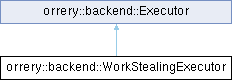
Inheritance diagram for orrery::backend::WorkStealingExecutor:
Public Member Functions | |
| WorkStealingExecutor (unsigned worker_count=0, ThreadPool::Affinity affinity=ThreadPool::Affinity::kUnpinned) | |
| void | run (core::Index count, RangeTask task) override |
| Call task over pieces that together cover [0, count) exactly once each, and return when all of them have finished. | |
| std::string_view | name () const noexcept override |
| The scheme's name, for benchmark tables and reports. | |
| unsigned | worker_count () const noexcept override |
| How many workers this executor divides work between. | |
| CoreClass | worker_core_class (unsigned worker) const noexcept override |
| What kind of core a worker runs on, where that is known. | |
| ExecutorStatistics | statistics () const override |
| The record of what the workers have done since the last reset. | |
| void | reset_statistics () noexcept override |
| Set every counter back to zero. | |
Static Public Attributes | |
| static constexpr core::Index | kChunksPerWorker = 16 |
| How many chunks each worker's share is broken into. | |
Additional Inherited Members | |
| Protected Member Functions inherited from orrery::backend::Executor | |
| Executor (const Executor &)=default | |
| Executor (Executor &&)=default | |
| Executor & | operator= (const Executor &)=default |
| Executor & | operator= (Executor &&)=default |
Detailed Description
Divides the range into equal shares and lets idle workers take from busy ones.
Member Function Documentation
◆ run()
|
overridevirtual |
Call task over pieces that together cover [0, count) exactly once each, and return when all of them have finished.
The division is the implementation's to choose, and so is the number of threads it uses and the order the pieces run in. A caller may rely on each index being covered exactly once and on all the work being complete on return, and on nothing else.
A count of zero runs nothing. An empty configuration is a configuration, and it reaches the solvers by the same path as any other.
Implements orrery::backend::Executor.
◆ name()
|
inlinenodiscardoverridevirtualnoexcept |
The scheme's name, for benchmark tables and reports.
Implements orrery::backend::Executor.
◆ worker_count()
|
inlinenodiscardoverridevirtualnoexcept |
How many workers this executor divides work between.
Implements orrery::backend::Executor.
◆ worker_core_class()
|
inlinenodiscardoverridevirtualnoexcept |
What kind of core a worker runs on, where that is known.
kUnknown unless the executor pinned its workers, because without pinning the operating system is free to move a thread between a performance and an efficiency core mid-region, and an answer that described where the thread started would be a guess about where it spent its time. Phase 6's per-core-class figures come from pinned runs for exactly this reason.
Implements orrery::backend::Executor.
◆ statistics()
|
nodiscardoverridevirtual |
The record of what the workers have done since the last reset.
Safe to call only when no region is running, which for a single submitting thread means any time run is not on the stack. It copies the per-worker records rather than returning a view of them, because a caller comparing two schemes needs the first scheme's numbers to survive the second scheme running.
Implements orrery::backend::Executor.
◆ reset_statistics()
|
overridevirtualnoexcept |
Set every counter back to zero.
A benchmark measures the region it timed rather than the warm-up before it, and once the two have been added together they cannot be separated.
Implements orrery::backend::Executor.
Member Data Documentation
◆ kChunksPerWorker
|
staticconstexpr |
How many chunks each worker's share is broken into.
This is the one tuning constant in the scheduler and it is a compromise between two costs. Larger chunks mean fewer lock acquisitions and fewer clock readings, but a coarser tail: the region cannot finish sooner than the last chunk started, so the residual imbalance is about one chunk. Smaller chunks balance more finely and cost more to hand out.
Sixteen puts the residual imbalance at roughly one part in sixteen of a worker's share, which is well under the two-to-one throughput difference between the core types this is here to absorb, while keeping the per-chunk overhead near a thousandth of the chunk. The value is not finely tuned and does not need to be: anything from about eight to sixty-four behaves the same on this machine, which is the sign of a constant sitting in the flat part of the curve rather than on a peak.
The documentation for this class was generated from the following file:
- orrery/backend/work_stealing_executor.hpp